























In market research, data quality determines the value of every decision made from survey findings. Organizations invest significant time and resources into questionnaire design, sample recruitment, and data analysis, yet one critical area often receives insufficient attention: survey programming quality assurance (QA).
A well-designed questionnaire can quickly become ineffective if programming errors exist within the survey. Broken skip patterns, incorrect branching logic, validation failures, quota issues, and reporting inaccuracies can significantly impact data quality and compromise research outcomes. Even minor programming mistakes can introduce bias, frustrate respondents, increase survey abandonment, and generate unreliable data.
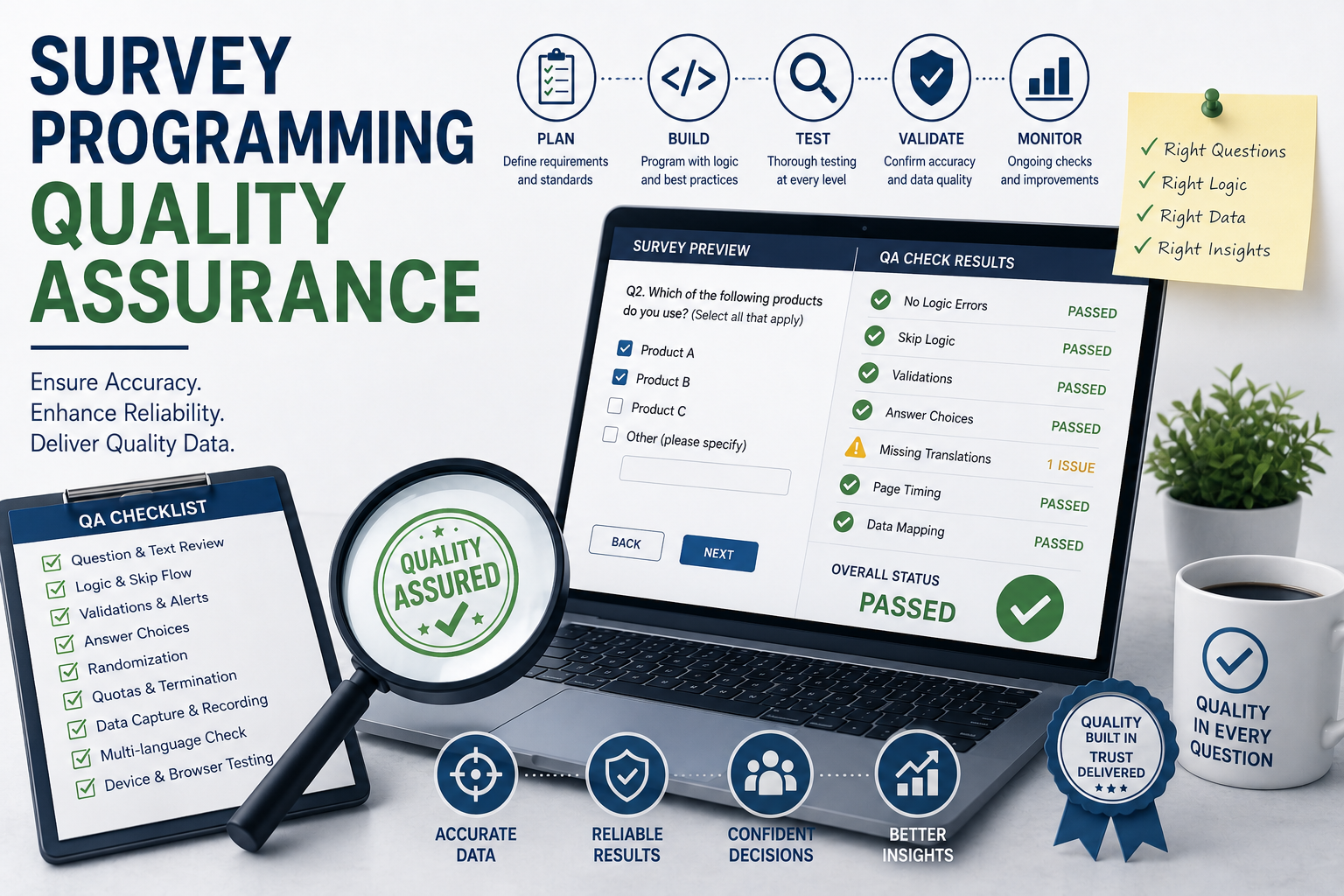
Survey Programming Quality Assurance (QA) is the systematic process of testing and validating every aspect of a programmed survey before it is launched to respondents. QA ensures that survey logic functions correctly, data is captured accurately, respondent pathways are validated, and the overall survey experience meets quality standards.
As market research studies become increasingly sophisticated, QA has evolved from a basic review process into a critical component of successful survey execution. Organizations that prioritize rigorous QA procedures consistently achieve higher data quality, improved respondent experiences, and more reliable research insights.
This comprehensive guide explores the importance of survey programming QA, the testing methodologies used by professional survey programmers, common quality issues, and best practices for maintaining high-quality survey data.
What Is Survey Programming Quality Assurance?
Survey Programming Quality Assurance is the process of systematically evaluating a programmed survey to identify and eliminate errors before data collection begins.
QA involves testing all survey functionality, including:
- Survey logic and skip patterns
- Branching conditions and routing paths
- Validation rules and required fields
- Quota controls and sample management
- Randomization, rotation, and piping
- Mobile and browser compatibility
- Data exports and database reporting structures
The objective is not simply to identify technical issues but to ensure that the survey accurately captures the exact information required for research objectives. It serves as the final, critical checkpoint between initial survey development and real-world respondent participation.
Why QA Is Critical in Market Research
Market research decisions often involve significant financial investments. Product launches, advertising campaigns, pricing strategies, customer experience initiatives, and brand positioning efforts frequently rely on survey findings. When survey programming errors occur, organizations risk making decisions based on inaccurate data.
For example, if a screening question contains a logic error, unqualified respondents may enter the survey. If quota controls fail, sample representation may become distorted. If validation rules are missing, incomplete or inconsistent responses may affect analytical outcomes. These issues can undermine the entire research project. A robust QA process helps eliminate these risks before fieldwork begins.
The Relationship Between QA and Data Quality
Data quality begins long before respondents complete a survey. The ultimate quality of collected data depends heavily on how effectively the survey has been programmed and tested.
Strong QA practices help ensure:
- Accurate respondent routing
- Proper qualification and termination procedures
- Consistent question presentation across cohorts
- Reliable quota management and valid response collection
- Accurate data mapping and storage formats
By identifying issues early, QA reduces the likelihood of complex data cleaning challenges and analytical errors later in the research lifecycle.
Logic Testing: The Foundation of Survey QA
Logic testing is one of the most important components of survey quality assurance. Modern surveys often contain complex pathways that guide respondents through different sections based on their answers. These pathways must function perfectly to ensure relevant questions are presented to appropriate respondents.
Logic testing verifies that:
- Respondents see the correct questions
- Ineligible participants are screened out immediately
- Branching conditions operate exactly as expected
- Survey pathways align seamlessly with core research objectives
Professional QA teams test every possible respondent scenario to confirm logic accuracy. Without thorough logic testing, surveys may collect incomplete or misleading information.
Testing Methodologies In Survey Programming QA
1. Skip Logic Validation
Skip logic allows surveys to automatically bypass questions that are not relevant to a particular respondent. For example, if a respondent indicates they have never used a specific product category, the survey must skip detailed product feature evaluations. QA teams verify that all skip conditions function properly, respondents are not routed incorrectly, and critical target questions are never skipped accidentally.
2. Branching and Routing Verification
Complex market research studies often require multiple respondent pathways. Branching logic determines which blocks respondents see based on previous profiles or statements. QA professionals carefully evaluate single-condition branching, multi-condition branching, nested logic pathways, explicit survey termination points, and technical re-entry scenarios.
3. Validation Rule Testing
Validation rules help prevent incomplete or inaccurate responses. This includes testing mandatory questions, numeric range restrictions, character limits, date constraints, and cross-question consistency checks. QA teams verify that validation rules trigger correctly and provide meaningful guidance to respondents without creating drop-off friction.
4. Quota Testing and Sample Management
Quota controls play a critical role in maintaining representative research samples. When studies require specific respondent distributions (demographics, regions, or industries), QA teams rigorously stress-test quota limits, soft quotas, hard quotas, real-time balancing, and overfill prevention mechanics.
5. Randomization and Rotation Testing
Randomization helps reduce survey order bias by varying the sequence of choices, questions, or product attributes. QA teams verify proper rotation logic, equal statistical distribution, and consistent randomization behavior across different interview sessions to protect research validity.
6. Piping and Dynamic Content Validation
Advanced surveys use piping to insert previous answers dynamically into later questions. QA testing ensures flawless data text insertion, structural formatting consistency, text accuracy, and flawless execution across multi-language implementations.
Cross-Device and Data Infrastructure Verification
Mobile and Browser Compatibility: Mobile participation heavily dominates online survey research. A layout that performs perfectly on a desktop display may encounter fatal usability issues on smartphones. QA teams systematically evaluate responsive layouts, touch target interactions, text readability, and browser compatibility across Chrome, Safari, Edge, and Firefox.
Data Export and Reporting Validation: Collecting data accurately is only part of the battle. QA teams explicitly review variable naming conventions, response coding, backend data mapping, and export database structures to ensure seamless compatibility with downstream analytical frameworks.
Soft Launch Operations: Before committing full sample budgets, a soft launch involves deploying the survey to a limited, controlled live audience. This live test allows operations teams to identify hidden logic errors, capture actual completion times, and verify real-world data capture structures under authentic server loads.
Common Survey Programming Errors Found During QA
A methodical quality assurance workflow frequently uncovers critical structural bugs before deployment, including:
- Broken skip logic patterns and dead-end pathways
- Missing data validations leading to incomplete text fields
- Misconfigured quota logic resulting in sample overfills
- Unmapped or mismatched data export variable codes
- Broken responsive formatting on mobile devices
Catching these critical issues prior to field launch directly shields project timelines and prevents budget waste.
Best Practices for Survey Programming QA
Successful research organizations deploy rigorous testing principles to ensure data integrity:
- Utilize independent testing teams separate from the main survey script developer
- Draft explicit, thorough test script blueprints outlining every conditional logic path
- Execute multiple, iterative testing rounds following logic corrections
- Enforce strict variable-naming conventions to ensure immediate analytics readiness
- Maintain detailed documentation mapping discovered bugs to their respective technical fixes
The Future of Survey QA
As survey technology evolves, QA processes are becoming increasingly sophisticated. Emerging operational workflows are actively adopting AI-assisted survey testing, automated script logic validation, predictive data quality monitoring, and real-time QA anomaly detection dashboards to discover operational bugs faster than ever.
Ensuring Trustworthy Insights Through Expert QA
Survey Programming Quality Assurance is one of the most important yet often overlooked components of modern market research. Effective QA ensures that surveys function correctly, respondents receive appropriate experiences, and data collection processes remain completely accurate and reliable.
From logic testing and validation checks to quota verification and mobile optimization, rigorous QA protects the integrity of research projects and helps organizations generate trustworthy insights.
At KnowledgeExcel, we combine technical execution with meticulous, multi-stage testing protocols. Our comprehensivesurvey programming and QA servicesare designed to guarantee data precision from the initial questionnaire build straight through to finalPower BI dashboardvisualizations.