
























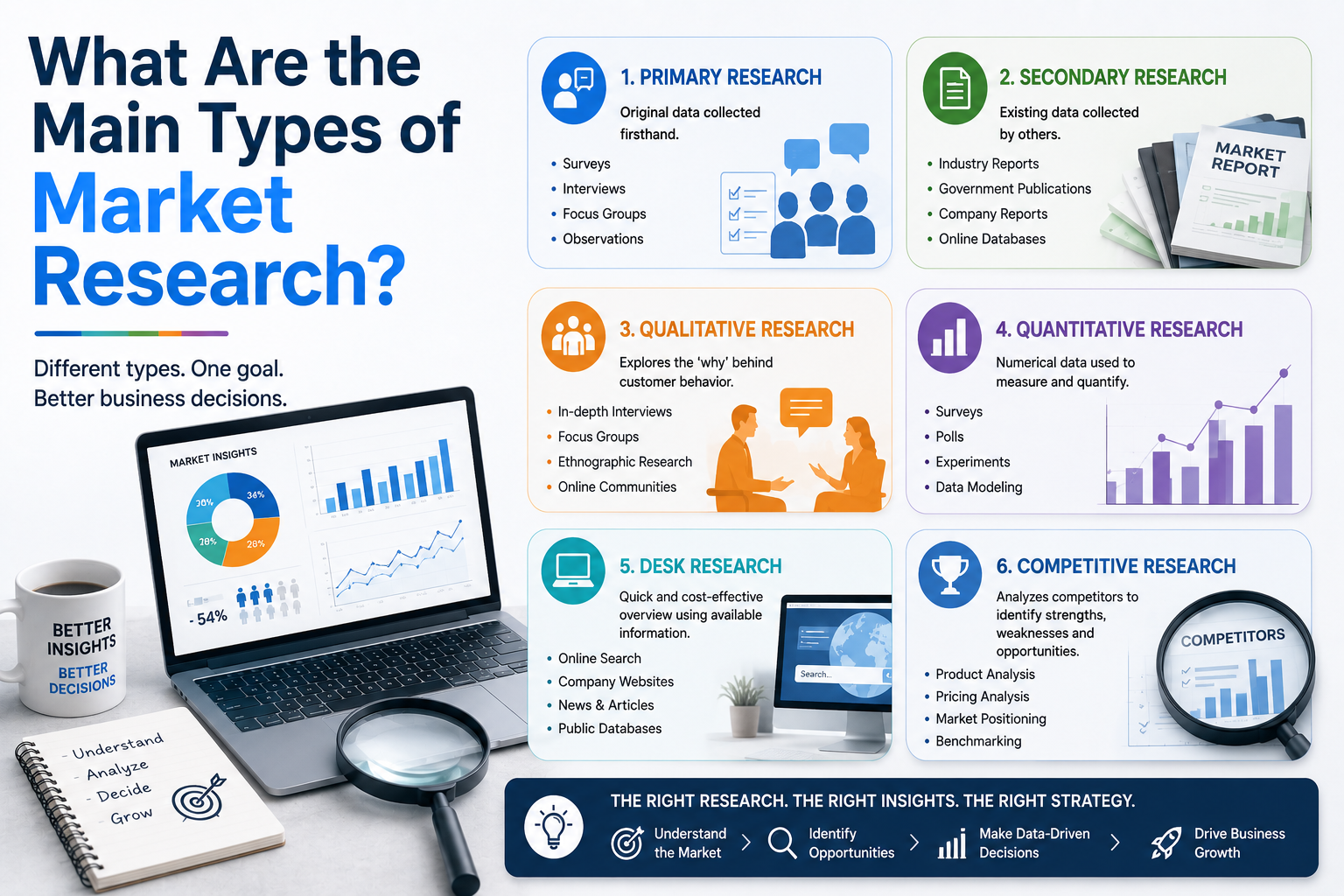
Here are some variations of market research that we will discuss in this article.
Primary Market Research:
This type of market research is conducted directly with customers and prospects. It can include surveys, interviews, focus groups, and observational studies.
Secondary Market Research:
This type of market research uses existing data, such as industry reports, government statistics, and data from other companies in the industry.
Quantitative Market Research:
This type of market research uses numerical data to uncover trends and insights. It can include surveys, polls, and experiments. Quantitative research is used to gather data systematically. This type of market research is good for measuring the size, shape, and changes in the trends of markets. Quantitative data is excellent for benchmarking changes over time and drawing conclusions based on statistical analysis. This is conducted using any primary or secondary research method, as long as the data can be 'quantified' in some way.
Qualitative Market Research:
This type of market research uses non-numerical data, such as interviews and focus groups, to explore customer opinions, attitudes, and behaviors. Qualitative research is a type of market research that uses interviews and questionnaire responses to gather data. Qualitative data is usually collected using open-ended questions, which allow participants to give free-form answers.
1. DESK RESEARCH:
This type of market research involves the collection of data from existing sources, such as industry reports, government websites, and other publicly available information.
2. BRAND RESEARCH:
The data you collect should be about the following areas:
3. BRAND AWARENESS:
Determine whether people have heard of your brand and where they may have learned about you.
4. BRAND PERCEPTION:
Learn how people feel about your brand, your mission, values, imagery, and activities.
5. BRAND POSITIONING:
Discover how people feel about your brand compared to your competitors.
6. PRODUCT RESEARCH:
This is used to determine how customers perceive a product's features, benefits, and usability. This type of research can help you identify the strengths and weaknesses of your products.
HERE ARE SOME OF THE WAYS YOU CAN USE MARKET RESEARCH TO IMPROVE YOUR PRODUCTS:
1. PRODUCT FEATURE TESTING:
Collect feedback on the usability and accessibility of new features in your app. This information can be used to improve this feature and give you insight into how to deploy future features.
2. CONCEPT TESTING:
Gauge how customers feel about a new product idea before the product launch or before you've even started creating it.
3. PRODUCT DEVELOPMENT:
Improve your product by surveying customer experience and competitor analysis.
4. PRODUCT MARKETING:
This is the process of promoting and selling a product to customers. This includes market research, product development, creating a brand image, and designing the marketing strategy for the product. The goal of product marketing is to understand the target audience and their needs and position the product in a way that will appeal to them, resulting in increased sales and customer satisfaction.
5. CUSTOMER RESEARCH:
This is used to learn about the needs and wants of customers. There are many types of customer research, but here are a few examples:
6. CUSTOMER SATISFACTION RESEARCH:
is used to measure customer satisfaction with a product or service. This type of research can help businesses determine how well their products are performing, improve customer service, and increase retention.
7. CUSTOMER SEGMENTATION RESEARCH:
is used to identify different groups of customers that have different needs and wants. This can help you find new markets to target, and find the best way to market your products to those groups.
8. COMPETITOR RESEARCH:
Marketing campaign effectiveness research is used to determine how well a business's marketing campaigns are working. Any movement will incur some cost to your business, so it's essential to identify the strategies that have the best ROI.
9. MARKETING CAMPAIGN EFFECTIVENESS:
research is used to determine how well a business's marketing campaigns are working. Any movement will incur some cost to your business, so it's essential to identify the strategies that have the best ROI.
10. WEBSITE OPTIMIZATION RESEARCH:
This is essential to improving search engine rankings and generating leads. By understanding how people browse and search for products and services, you can create effective marketing campaigns to attract new customers.
11. CONTENT RESEARCH:
This is used to determine what content is most effective for a business's marketing campaigns. By identifying the topics that resonate with customers, you can create engaging and informative content.
12. KEYWORD RESEARCH:
This is essential for any business that wants to improve its online presence and increase sales. By identifying the right keywords, companies can create effective campaigns that target specific markets and attract new customers. The real focus here is increasing visibility for your posts and pages, which is to say ranking higher in search engines. But you need to follow this up with high-quality content to keep people coming back to your site.
Core Market Research Methodologies
Primary Market Research
This type of market research is conducted directly with customers and prospects. It can include surveys, interviews, focus groups, and observational studies.
Secondary Market Research
This type of market research uses existing data, such as industry reports, government statistics, and data from other companies in the industry.
Quantitative Market Research
This type of market research uses numerical data to uncover trends and insights. It can include surveys, polls, and experiments, often requiring advancedsurvey programming. Quantitative research is used to gather data systematically. It is excellent for measuring the size, shape, and changes in the trends of markets, benchmarking changes over time, and drawing conclusions based on statistical analysis.
Qualitative Market Research
This type of market research uses non-numerical data to explore customer opinions, attitudes, and behaviors. Qualitative data is usually collected using open-ended questions, allowing participants to give free-form answers.
Specific Types & Applications of Market Research
1. Desk Research
This type of market research involves the collection of data from existing sources, such as industry reports, government websites, and other publicly available information.
2. Brand Research
The data you collect should evaluate the overall health and positioning of your corporate identity. Key areas include:
3. Product Research
This is used to determine how customers perceive a product's features, benefits, and usability. This type of research can help you identify the strengths and weaknesses of your products.
Here are some of the ways you can use market research to improve your products:
4. Customer Research
This is used to learn about the needs and wants of customers. There are many types of customer research, but key examples include:
5. Competitor Research
Researching competitors allows businesses to identify gaps in the market, benchmark pricing strategies, and understand the strengths and weaknesses of alternative offerings in the industry.
6. Marketing Campaign Effectiveness
This research is used to determine how well a business's marketing campaigns are working. Any movement will incur some cost to your business, so it's essential to identify the strategies that have the best ROI.
7. Website Optimization Research
This is essential to improving search engine rankings and generating leads. By understanding how people browse and search for products and services, you can create effective marketing campaigns to attract new customers.
8. Content Research
This is used to determine what content is most effective for a business's marketing campaigns. By identifying the topics that resonate with customers, you can create engaging and informative content.
9. Keyword Research
This is essential for any business that wants to improve its online presence and increase sales. By identifying the right keywords, companies can create effective campaigns that target specific markets and attract new customers. The real focus here is increasing visibility for your posts and pages (ranking higher in search engines), but you must follow this up with high-quality content to keep people coming back to your site.